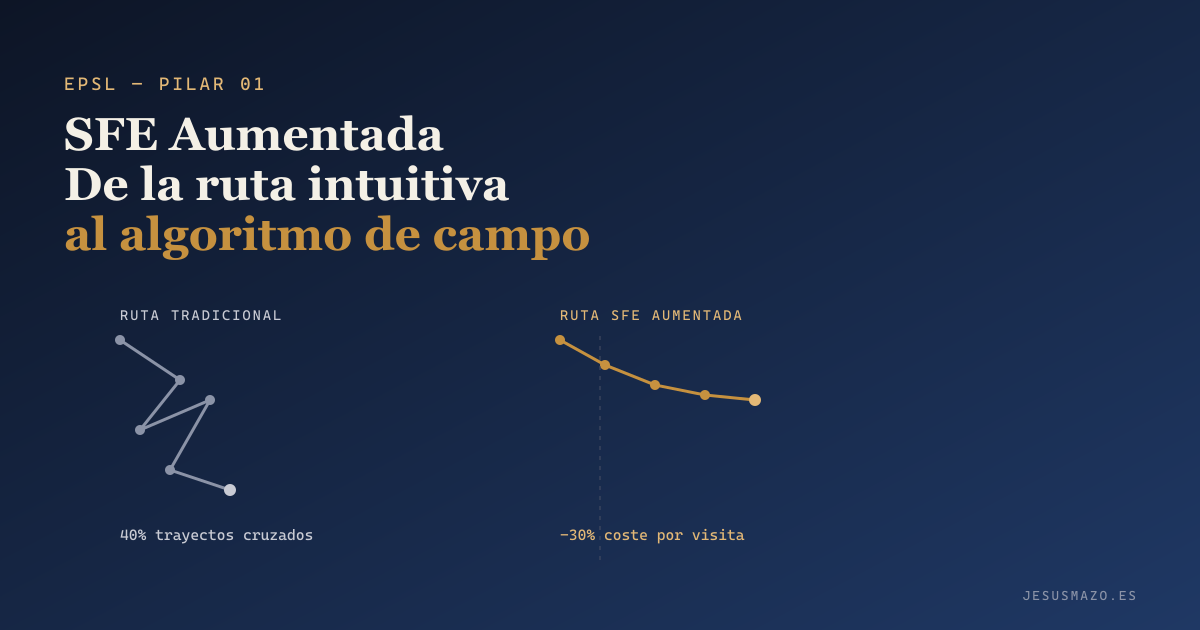
At a cycle review meeting, someone praised the top rep in the region for covering over 15,000 km visiting primary-care physicians that quarter. "That's commitment," the Commercial Director said, visibly pleased. Everyone applauded. Everyone except one person from Commercial Excellence, who was staring at a spreadsheet with a frown.
Weeks later, someone audited that rep's routes using a basic geospatial clustering model. The diagnosis was brutal: of the total distance covered, nearly 40% consisted of inefficient, crossed-over trips, born from manual, intuition-driven planning and last-minute calls. 30% of the physicians visited were low-potential, while 10% of high-potential specialists hadn't received a single visit in the prior cycle. Real conversion on the portfolio had dropped 12%.
That rep was, in all likelihood, a genuinely committed professional. But they had no clear direction, no proper training, and were a victim of a blind, reactive system. We were rewarding fatigue and mileage — not operational efficiency.
In elite Commercial Direction, a sales network's productivity isn't measured by how exhausted the team is or how many kilometers they've driven — it's measured by the mathematical precision of its deployment and the operational profitability of its work. That's what I mean by SFE Augmented: moving from the fixed routes of a few years ago to dynamic, AI-driven optimization. It's time to stop measuring kilometers driven and start measuring real EBITDA impact.
The diagnosis: three recurring design flaws
When I audit the field logistics of a commercial team, the same pattern shows up again and again, across different sectors and different teams:
The drag of crossed-over routes. Without predictive planning, each rep designs their own route intuitively — last-minute calls, improvised cancellations, personal preferences for certain accounts. The result is a visit map that looks drawn at random.
Poorly distributed coverage. High-potential prescribers in major urban hubs go underserved while peripheral, low-potential practices get covered — simply to hit the company's daily visit quota.
The real cost per visit. Traditional commercial direction calculates average visit cost as a flat blend of consolidated expenses. SFE breaks down the real cost of each physical touchpoint, factoring in unproductive time:
When that denominator isn't carefully managed — when low-value contacts get counted as "effective visits" — the unit cost of each visit climbs well past what's sustainable, and that overrun hits net margin directly.
The theory: what changes with SFE Augmented
The Augmented Leader doesn't let their commercial network fall victim to a blind system. They focus on optimizing routes, prioritizing the zones, hospital hubs and accounts that are genuinely strategic and high-potential — not simply the ones that are closer or have been in the portfolio longer.
In practice, this means three structural shifts:
Dynamic territories, calculated through spatial clustering algorithms that adapt automatically to real potential density, rather than administrative borders inherited from years ago.
A predictive CRM that suggests and reorders the day's route based on real-time traffic and stock alerts at nearby points of sale — not a fixed list the rep follows without question.
Channel coexistence governed by digital signals: the in-person visit is triggered deterministically only when the system detects a prior high-value digital interaction from the client or prescriber, avoiding cold visits altogether.
Technology here doesn't replace the salesperson — it replaces improvisation. A team equipped with these algorithms doesn't waste time; they arrive at the appointment to validate and close already-prequalified opportunities.
Illustrative case: same launch, two philosophies
Two organizations tackle the simultaneous launch of a treatment with identical commercial structures — 70 reps — but opposite operating philosophies.
- Territories split by rigid postal codes, unchanged for years.
- Reps in major cities unable to cover full high-potential reach; reps in peripheral zones driving hundreds of km to reach low-potential accounts.
- Cost per visit: +25% versus target.
- Geospatial clustering by each prescriber's real effective potential.
- Route re-sequenced every morning based on real-time traffic and stock.
- High-potential coverage at 60% within 3 months; cost per touchpoint down 30%.
A high-potential prescriber's consultation is the real EBITDA factory of any commercial network. In today's market, you can't send teams out to compete without the guidance of data precision.
The personal lesson: the 2+1 rule
At my first company, I had the good fortune of working with an Operations Director who always repeated the same line: "luck doesn't exist." I didn't truly understand it until a whirlwind trip to Mannheim, where we were presenting plant results to the Board. I was a young trainee; he had the presentation prepared three times over — the file sent ahead to Central, a local copy on his laptop, a USB drive, and, in case everything else failed, a set of printed transparencies for an overhead projector.
And, of course, the technology failed. The video projector crashed five minutes before the session. He didn't flinch: he borrowed an overhead projector from the Mannheim plant director, set out his transparencies, and started the session. Thirty minutes later he had delivered the entire presentation flawlessly, while every other meeting that day started more than an hour late.
Years later, leading commercial networks and designing SFE strategies, I understood that "the 2+1 rule" wasn't paranoia — it was margin engineering and operational discipline. An SFE Augmented model applies that exact same logic to commercial governance:
Plan A — the optimized algorithmic route, calculated from effective potential and prior digital signals. Plan B — real-time predictive rerouting if an appointment falls through or traffic collapses. Plan C — omnichannel coexistence: if the in-person visit fails, the system automatically triggers a high-value digital touchpoint so the cost already invested in that opportunity isn't wasted.
Governing a sales force isn't about chasing teams with a GPS. It's about building the architecture so they never have to depend on luck on the road.
Executive close: three questions for the Commercial Director
- 1. What real percentage of your commercial team's day is currently lost to driving or manual logging, versus actual time spent with clients?
- 2. Are your territories balanced against real potential, or do they still follow the same administrative borders from years ago?
- 3. Does your commercial team plan disconnected from every other channel and campaign, or do you already have a dynamic coexistence flow built into your CRM?